Highlights
- The Arizona House adjourned at 4:45 a.m. Saturday after a 19-plus-hour session; the Senate wrapped at 12:30 a.m.
- Republicans passed multiple concurrent resolutions — including election ID rules and school voucher protections — that go to voters without requiring Gov. Katie Hobbs's signature.
- A deal between legislative Republicans and the Arizona Education Association over the school voucher program collapsed, triggering passage of two competing ballot measures.
- The 2026 session set a record with 2,190 bills proposed; Hobbs signed 125 of 188 bills sent to her and vetoed 63.
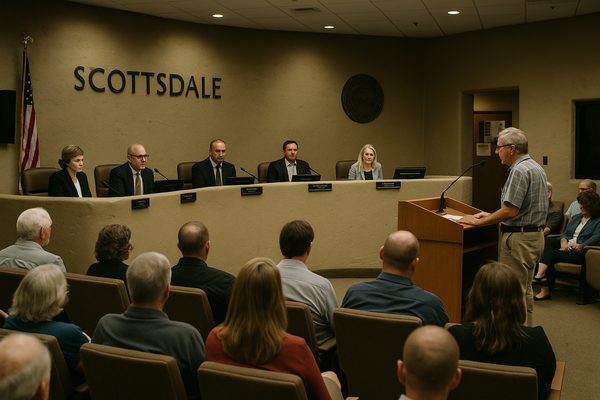
Republicans in the Arizona Legislature adjourned the 2026 session in the pre-dawn hours Saturday, using the final day to send a string of constitutional amendments and statutory changes directly to November voters, a procedural end-run around Gov. Katie Hobbs, who has vetoed 63 bills this year.
The Senate voted to end the session at around 12:30 a.m. Saturday. The House of Representatives wrapped at 4:45 a.m., closing what the Arizona Mirror reported was the 152nd and final day of the session. The session began Jan. 12 and set a record for the most legislation proposed, with 2,190 bills, memoriams and resolutions.
Bills require a majority in both chambers and the governor's signature to become law. Concurrent resolutions require only approval from both chambers, placing measures on the ballot for voters to decide. Republicans used that distinction to advance policies they acknowledged Hobbs would veto.
Among the measures sent to voters: an amended version of House Concurrent Resolution 2001, an election overhaul that would prohibit foreign nationals from spending money to influence elections, require government identification before casting a ballot in every election, and require all polling locations to provide on-site tabulation of ballots for voters who want it. Republican Rep. Alexander Kolodin has been trying to pass the measure for two years. Sen. Jake Hoffman and other Republicans said the resolution would not affect vote-by-mail, though Democrats and county elections officials raised concerns. Sen. Analise Ortiz, D-Phoenix, called it a voter suppression measure.
The Senate also voted along party lines to approve House Concurrent Resolution 2044, a Goldwater Institute-authored measure that would, according to the institute, "enshrine permanent protections against racially discriminatory DEI practices and programming throughout all state institutions, including K-12 schools and universities." Senate Concurrent Resolution 1004, sponsored by Sen. Wendy Rogers, R-Flagstaff, would ask voters to prohibit cameras from enforcing speeding and red light laws unless voters in a given community specifically approve their use.
What happened to the school voucher deal?
A negotiated agreement between legislative Republicans and the Arizona Education Association, under which the AEA would drop its campaign to restrict the universal voucher program in exchange for Republicans abandoning a measure that would prohibit school districts from deducting union membership fees from employee paychecks, fell through. After the collapse, both chambers voted along party lines to put the union-related House Concurrent Resolution 2040 to voters. Republicans also passed House Concurrent Resolution 2048, which they called the "Military Families College Savings and Scholarship Protection Act," a constitutional amendment that Democrats said would effectively bar any reforms to the Empowerment Scholarship Account voucher system. Democrats accused Republicans of using military families as a political tool.
At nearly 4 a.m., the House approved Senate Concurrent Resolution 1032, which would require most school districts to spend at least 60% of operational funding on direct instructional expenses. The requirement would apply to districts with 7,500 or more students and all districts in Maricopa, Pima, and Pinal counties; noncomplying districts could see Classroom Site Fund allocations cut by 25% annually until zeroed out.
The session's final hours were marked by open conflict. Republican Rep. Neal Carter screamed at House Minority Leader Oscar De Los Santos for what Carter said was a violation of House rules; De Los Santos accused Carter of attempting to start a physical fight. Senate President Warren Petersen barred a group of school teachers from the public gallery, citing what he described as an illegal disruption and disorderly conduct. Democratic Rep. Alma Hernandez, of Tucson, blamed her own party for agreeing to support the bipartisan budget without securing a guarantee that Republicans would end the session immediately after the budget vote Thursday.
"We knew this was going to happen, and here we are, bringing all the bills that never made it, or either died, and then they came back to life, and then we're here at 3:36 a.m. passing bills that the governor has no ability to veto," Hernandez said.
For Scottsdale and Paradise Valley property owners and business operators, the Maricopa County school-spending mandate and the voucher ballot measures carry the most direct exposure: both touch district budgets and the ESA program that has reshaped private-school enrollment and real-estate demand across the northeast Valley. The November ballot will determine whether those changes hold.
All measures approved as concurrent resolutions are scheduled for the November 2026 general election ballot.
Sources
Every factual claim in this article traces to one of the sources below. See how we work for the editorial process.
- azmirror.com retrieved 13/06/2026 14:48
Authored by The Scottsdale Signal. Drafted by AI from primary-source material under our beat-specific editorial guides; reviewed by humans before publish under our five-gate process. Sources retrieved at 13/06/2026 14:48. Every claim traces to a source.