Highlights
- The Arizona Supreme Court voted 4-2 Tuesday to keep Proposition 144, a sweeping GOP election measure, on the November ballot.
- Prop. 144 was written by Scottsdale Republican Rep. Alexander Kolodin, who is also challenging Secretary of State Adrian Fontes in November.
- The measure would require voter ID in every election, mandate on-site ballot tabulation, and bar foreign nationals from giving to political committees.
- A separate court ruling on the ballot description of Prop. 144 is due by the Aug. 20 printing deadline.
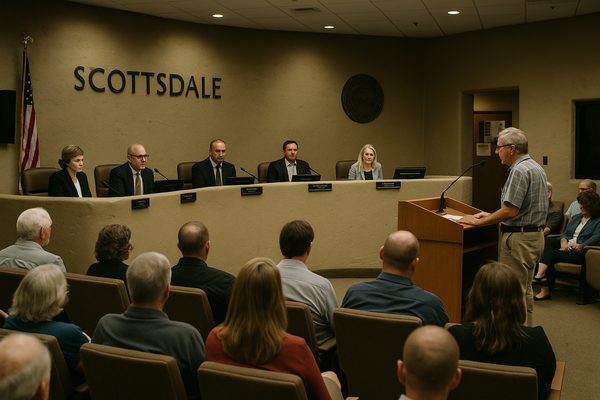
The Arizona Supreme Court ruled Tuesday that Proposition 144, a Republican-backed constitutional amendment making broad changes to how elections are conducted, can remain on the November ballot, rejecting a challenge from a Tempe city councilman who argued the measure violated the state constitution's single-subject requirement.
Vice Chief Justice John Lopez wrote for the majority that the provisions in Prop. 144 were topically related because they all pertain to the administration of Arizona elections. "They embrace the single general topic of election administration of public elections; they concern a single new constitutional section; and they are qualitatively similar in their shared aim of ensuring that Arizona elections are decided by, and only by, eligible citizen voters," Lopez wrote. Justices James Beene, Bill Montgomery and Kathryn King joined the majority.
The measure, formally titled the "Fast Accurate Secure Transparent Election Results Act," would prohibit foreign nationals from spending money to influence state elections, require every voter to show government identification before casting a ballot in every election, and require all polling locations to provide on-site tabulation of ballots for voters who want it. It would also create a new standard for challenging election laws enacted by the state legislature, and add a constitutional provision declaring that only citizens may register and vote in Arizona elections.
Prop. 144 was written by state Rep. Alexander Kolodin, a Scottsdale Republican. Kolodin is the Republican nominee challenging Democratic Secretary of State Adrian Fontes for reelection in November. The Arizona Mirror reports he is an attorney and election denier who was sanctioned by the Arizona State Bar in 2023 for his part in lawsuits challenging the 2020 election. Prop. 144 was one of five last-minute ballot referrals Republicans approved along party lines on the final day of the legislative session in June.
Tempe City Councilman Randy Keating brought the constitutional challenge, arguing Prop. 144 violated the Arizona Constitution's Separate Amendment Rule. A trial court dismissed his arguments last week; the Supreme Court concurred Tuesday.
Chief Justice Ann Timmer and Justice Maria Elena Cruz dissented, writing that provisions requiring on-site tabulation and a new standard for challenging election laws are distinct enough from the rest of the measure that voters should decide on them separately. Justice Clint Bolick recused himself.
The ruling was corroborated by the Arizona Capitol Times.
The court has yet to rule on whether Secretary of State Fontes must change the ballot description of Prop. 144; the Trump-aligned America First Legal Foundation challenged the description as misleading. The court must act by the Aug. 20 ballot printing deadline.
Sources
Every factual claim in this article traces to one of the sources below. See how we work for the editorial process.
- azmirror.com retrieved 19/08/2026 00:25
Authored by The Scottsdale Signal. Drafted by AI from primary-source material under our beat-specific editorial guides; reviewed by humans before publish under our five-gate process. Sources retrieved at 19/08/2026 00:25. Every claim traces to a source.