Highlights
- Phoenix launched the Midtown Core Transportation Study on May 6, covering streets from 19th Avenue to 16th Street between McDowell Road and Dunlap Avenue.
- The study was triggered by a resident petition to the Phoenix City Council requesting changes to reversible lanes that switch direction during rush hour.
- Consulting firm WSP is gathering data at roughly 60 intersections and 30 to 40 speed-monitoring points over a two-week period.
- A 2021 city study found removing the lanes could slow travel times by more than 40%; the new report goes to council in the fall.
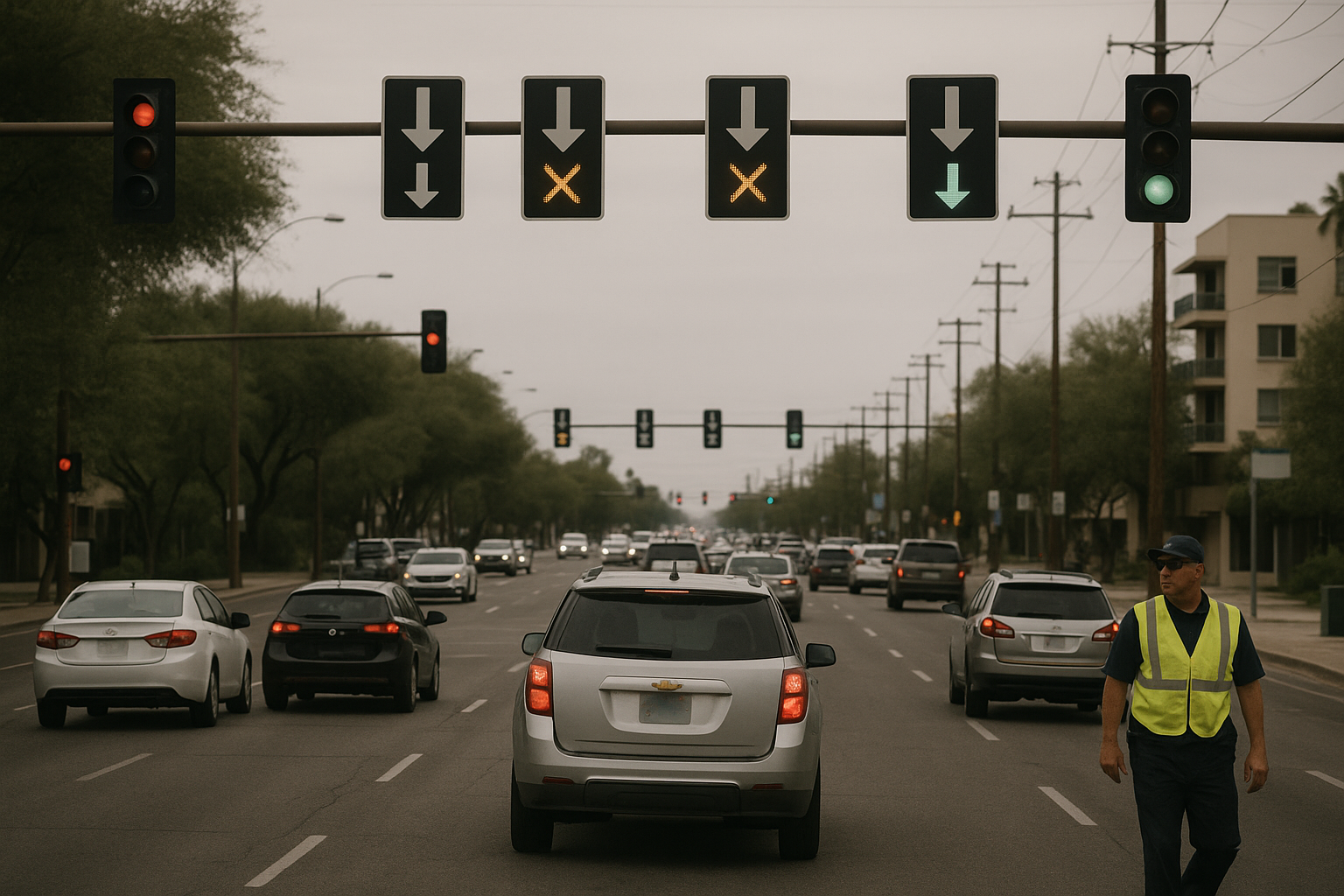
Phoenix is conducting a fresh examination of the reversible lanes on Seventh Street and Seventh Avenue, center lanes that flip direction during rush hour and have drawn resident complaints, petitions, and at least one documentary film, after the Phoenix City Council directed the Street Transportation Department to take a comprehensive look.
The Midtown Core Transportation Study will examine streets between 19th Avenue and 16th Street, from McDowell Road north to Dunlap Avenue, city officials announced Wednesday. The first public meeting is set for 6 p.m. Thursday.
Matt Wilson, assistant director of the Phoenix Street Transportation Department, said the effort was triggered by residents. "There was a petition submitted to our city council asking for a change in the reversible lanes," Wilson told reporters Wednesday. "There was a discussion at council that resulted in a request for street transportation to conduct a comprehensive study."
Scott Beck, with consulting firm WSP, is leading the study. Crews are gathering traffic data at about 60 intersections and 30 to 40 speed-monitoring points across the study area over a two-week period. The analysis will also draw on historical traffic records, crash patterns, congestion and queuing, lane usage, and anonymized cellphone data.
What could actually change?
Possible outcomes range from new signal technology and street redesigns within existing rights-of-way to modifications or outright removal of the reversible lanes. "We'll also evaluate options for the reversible lanes, including modifications, improvements or the potential removal," Beck said. Any changes will involve trade-offs: "This task will be about balancing safety, mobility, access and the community needs to develop practical, well-rounded solutions for the future," Beck said.
The lanes have operated since 1979 on Seventh Avenue and since 1982 on Seventh Street, created as a cost-effective alternative when widening the corridors was not practical, according to the city's project page. A December 2021 city study found eliminating the reversible lanes would increase travel times by more than 40 percent in some segments and recommended retaining them. The new study does not presuppose that conclusion.
Critics have long argued the lanes create hazards for drivers, pedestrians, and nearby businesses. "Our streets should be for people, not just for cars," Urban Phoenix Project board member Jamie Trufin said in a 2024 editorial for the Arizona Republic. "That's what highways are for."
Wilson noted that density is part of the calculus. "People are definitely asking for some traffic improvements, how things will function as growth continues," he said.
The study will proceed in four phases: corridor analysis, scenario development, identifying a preferred plan, and a final report. That report is due to the Phoenix City Council in the fall. A virtual town hall Thursday night opens a public comment period Wilson said will run approximately one month.
The study area and its outcome carry indirect relevance for Scottsdale and Paradise Valley property owners whose employees, tenants, and customers commute through the Seventh Street and Seventh Avenue corridors daily. A final council vote on any lane changes is expected after the fall report is delivered.
Sources
Every factual claim in this article traces to one of the sources below. See how we work for the editorial process.
- ktar.com retrieved 07/05/2026 00:09
- phoenix.gov retrieved 07/05/2026 00:09
Authored by The Scottsdale Signal. Drafted by AI from primary-source material under our beat-specific editorial guides; reviewed by humans before publish under our five-gate process. Sources retrieved at 07/05/2026 00:09. Every claim traces to a source.