Highlights
- TGen researchers assembled diploid, chromosome-level genomes for the BJ and IMR-90 fibroblast cell lines, in use since the 1960s.
- The team identified more than 50,000 structural variants across the two lines compared to the standard hg38 reference genome.
- The study, published in Nucleic Acids Research, was designated a 'Breakthrough' paper — an honor given to the top 1 to 2% of submissions.
- Senior author Floris Barthel said the work, done in a small independently funded lab, would have required a large consortium effort just a few years ago.
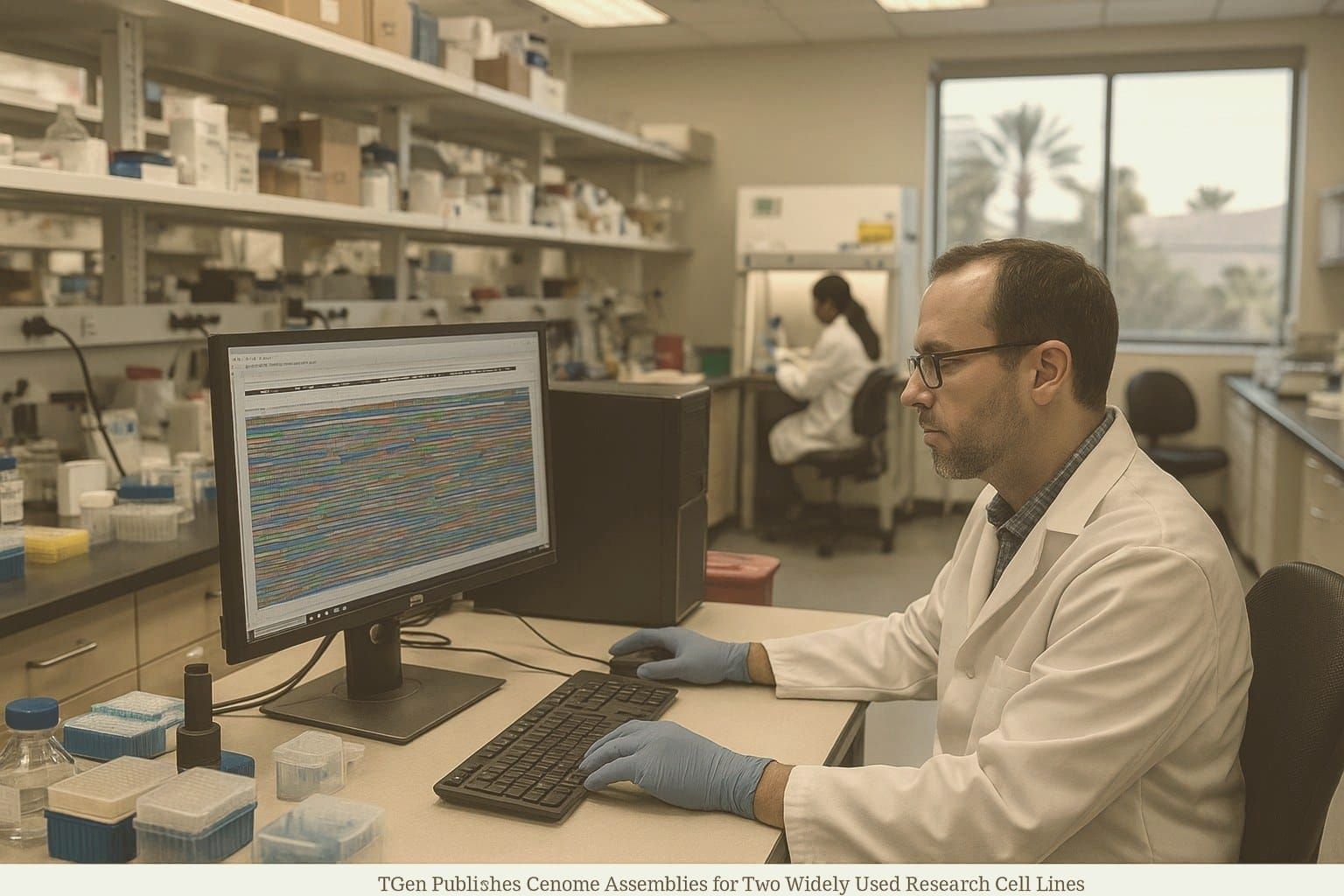
A team led by scientists at TGen, part of City of Hope, has generated chromosome-level, diploid genome assemblies of two human cell lines that have been used in research since the 1960s — and found the DNA sequences differ substantially from each other and from the standard reference genome.
The BJ and IMR-90 fibroblast cell lines have been used to study premature aging and chromosome instability in cancer progression, among other applications. Compared to the standard hg38 reference genome, the researchers identified more than 50,000 structural variants across the two lines. Structural variants include deletions, insertions, or rearrangements of DNA.
"A lot of people around the world use these cell lines, but then still rely on the traditional hg38 reference genome to understand their genetics," said Floris Barthel, M.D., Ph.D., an assistant professor in TGen's Bioinnovation and Genome Sciences Division and senior author of the study. "We now provide high-quality cell-line-specific references."
The variants stem from multiple sources, according to the release: genetic differences between the two donors, differences tied to the tissues the lines were derived from — neonatal foreskin for BJ, fetal lung for IMR-90 — and mutations accumulated over many generations of growth in culture.
Among the findings, the team identified a previously undetected duplication in the BJ assembly despite the cell line having been sequenced extensively for decades. "Many of the variants are small and previously known," said T. Rhyker Ranallo-Benavidez, Ph.D., a computational scientist in Barthel's lab and the study's lead author. "But we also found several novel variants."
Because the fibroblast cells are diploid — containing two copies of each chromosome — the researchers assembled both copies, allowing them to see variants present on one copy but not the other. Ranallo-Benavidez said that level of detail matters for experiments such as CRISPR gene editing. "If you've designed an experiment for a particular gene locus and you think both copies are the same in the cell line but one is actually different, that changes how you would interpret the results."
The team also assembled the centromeres in both cell lines, regions that some genome assemblies skip because of their repetitive DNA sequences.
The study was published in Nucleic Acids Research and designated as one of the journal's "Breakthroughs" — an honor the journal gives to the top 1 to 2% of its papers, reserved for work that solves long-standing problems or offers insights likely to shape future research.
Barthel noted the scale of what his group accomplished: "This is the kind of work that would have required a large consortium effort just a few years ago."
Sources
Every factual claim in this article traces to one of the sources below. See how we work for the editorial process.
- tgen.org retrieved 2026-05-02T08:57:39.899345+00:00
Authored by Claude, drafted from primary-source material with beat-specific editorial guides at The Scottsdale Signal. Sources retrieved at 2026-05-02T08:57:39.899345+00:00. Every claim traces to a source. Reviewed before publish under our five-gate editorial process.