Highlights
- The National Science Foundation obligated $675,354 to Arizona State University for research into altermagnetism in two-dimensional van der Waals materials.
- Principal investigator Seth Tongay will run the project from July 15, 2026 through June 30, 2029 under NSF's Condensed Matter Physics program.
- Altermagnetism is a recently identified form of magnetism that the abstract says may enable faster, more energy-efficient information storage than current approaches.
- The award is one of several NSF grants flowing to ASU this cycle, including a $199,998 quantum computing award and a $575,942 MRI engineering grant.
The National Science Foundation has obligated $675,354 to Arizona State University for a three-year investigation into whether a newly identified form of magnetism can exist in materials only one or a few atomic layers thick, according to NSF Award 2534832 posted to the agency's public database.
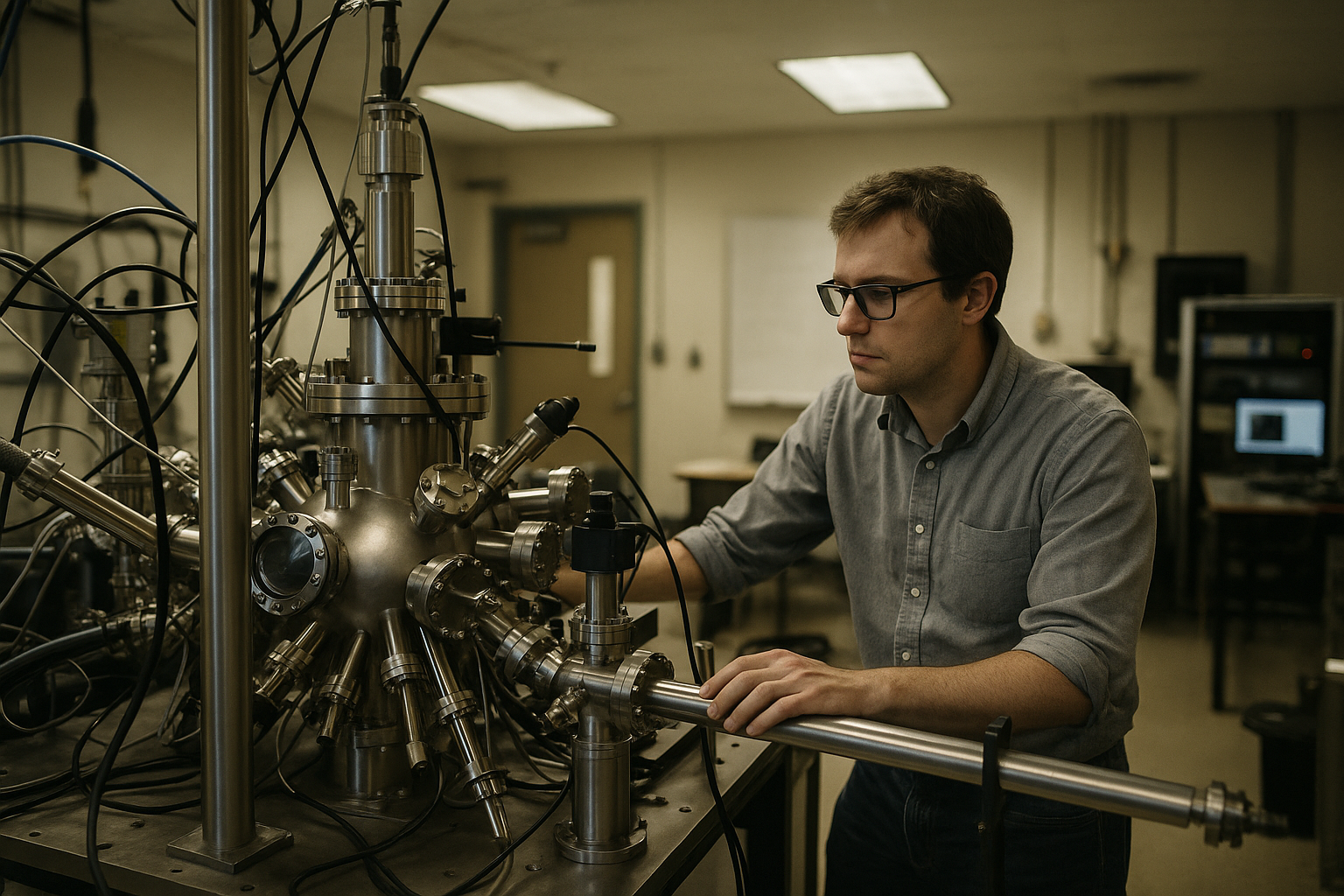
Principal investigator Seth Tongay will lead the project, which runs from July 15, 2026 through June 30, 2029 and is funded through NSF's Condensed Matter Physics program. The research targets altermagnetism, a form of magnetism the award abstract describes as potentially enabling devices that move and store information faster and more energy-efficiently than current approaches. The central question is whether that behavior, so far confirmed only in bulk materials, can be reproduced in two-dimensional van der Waals materials whose properties can be tuned by thickness, stacking, twisting, chemical design, and external fields.
The grant is part of a broader wave of NSF funding reaching ASU's Scottsdale-listed address this cycle. Separate awards include $199,998 for noise-aware quantum computing optimization led by Baoyu Zhou, $575,942 for a next-generation MRI radiofrequency platform led by Sungmin Sohn, and $419,790 for topological control of excitons in twisted semiconductors led by Sandhya Susarla, all with overlapping award periods ending in 2029 or 2031.
ASU's appetite for federal research capital is well established. NSF awarded the university $90.8 million in March 2023, at the time the largest NSF research award in the university's history, to build a compact X-ray free electron laser at its Biodesign Institute on the Tempe campus.
What is altermagnetism and why does it matter for technology?
Altermagnetism is a phase of magnetic order distinct from conventional ferromagnetism and antiferromagnetism. The NSF abstract states it may allow future devices to move and store information faster and more energy-efficiently than current approaches, with potential applications in computer memory, sensors, navigation systems, electric vehicles, and medical imaging. Whether it can be induced or controlled in atomically thin materials remains an open question the Tongay project is designed to answer.
The award also funds training for postdoctoral researchers, graduate students, and undergraduates in materials synthesis, computational modeling, and advanced measurement, along with public outreach through classroom engagement and hands-on demonstrations.
The award period opens July 15, 2026.
Sources
Every factual claim in this article traces to one of the sources below. See how we work for the editorial process.
- nsf.gov retrieved 12/07/2026 01:22
- nsf.gov retrieved 12/07/2026 01:22
- nsf.gov retrieved 12/07/2026 01:22
- nsf.gov retrieved 12/07/2026 01:22
Authored by The Scottsdale Signal. Drafted by AI from primary-source material under our beat-specific editorial guides; reviewed by humans before publish under our five-gate process. Sources retrieved at 12/07/2026 01:22. Every claim traces to a source.